
Photography is a wonderful tool for storytelling. It is not just the practice of creating appealing and visually interesting pictures, but it is about telling stories, real or fantasised. Using photographs to tell a story was something that, coincidentally, our recent speaker, Phil Savoie, encouraged us to try – so here’s your chance to have a go and to share your ‘story’ with others in the Club.
The best photos have more to them than just a first impression. They can create a sense of place, personality or emotion more clearly and quickly than the written word. We often aspire to tell a story with a single frame, but telling a story in a sequence of several photos opens up many more possibilities, with multiple ways of making the story more interesting and compelling.
The Challenge
The idea of this Challenge is to tell a story using five images. Your story can be about anything you like and in any style to suit your creativity. You can use images from your archives or go out and capture new ones. If you’re going to take new ones, it’s worth planning how you are going to visualise the story in advance. There’s no dialogue, so you’ll need all the information to be visual, but if you are wondering whether five photos will be enough to tell your story, bear in mind that each individual photo can contain a considerable amount of information.
How to tell an interesting and compelling story
Before you can start to tell a story, you need to have a good idea what the story will be. A good story changes over time, with a beginning, a middle and an end. You can tell a ‘closed’ story with a fixed beginning and a fixed end, and where everyone will come roughly to the same conclusion, or the story can be ‘open’ to interpretation.
Including a character allows the viewer to connect with the story, providing a source of emotion and showing how they change over time. You’ll also need to consider the location and atmosphere to help the viewer imagine your story.
Tips
- The viewer will process each image independently then connect multiple images into a cohesive storyline. The first and last images in a series are the most important; they need to be strong enough to grab a viewer’s attention.
- The composition of your images is important. Aim for some variety. A wide-angle shot can allow the viewer to visualise the bigger picture, and a path or corridor might provide a sense of direction (and including only a small section might give a feeling of trepidation).
- It’s important to make sure that the viewer knows what to look at in your images. A clearly defined subject or focal point can be helpful, perhaps by getting close to your subject or leading the eye towards the subject. Try to avoid cluttered photos.
- The main focus will be on the character(s). Emotions can be communicated through body language – is the subject happy or sad, relaxed or distressed? A dog, for example, might have its tail between its legs or be wagging its tail happily. However, not all images must contain a human or animal figure to be emotionally strong. Including landscapes or abstracts can also evoke strong emotions.
- Consider the kind of lighting that is appropriate for the story you are telling. For example, harsh lighting provides a sense of drama, whereas soft light gives a gentler more intimate atmosphere.
- To enhance the mood of the story you are telling, think about how best to process your images. Will black and white images tell your story better than colour, or would vibrant colours be more in keeping with the atmosphere? Experiment with a colour scheme. Warm colours heighten feelings of enjoyment and red invokes feelings of passion or pleasure, whereas cool colours give a sense of uncertainty and isolation.
Choosing your five photos – some guidelines (not rules!)
Just like a written essay, your photographic story needs to be structured. As mentioned already, a ‘closed’ story has a fixed beginning and end point. The series of images in between need to work well to create a linear narrative.
An example: ‘A magical birthday party:’
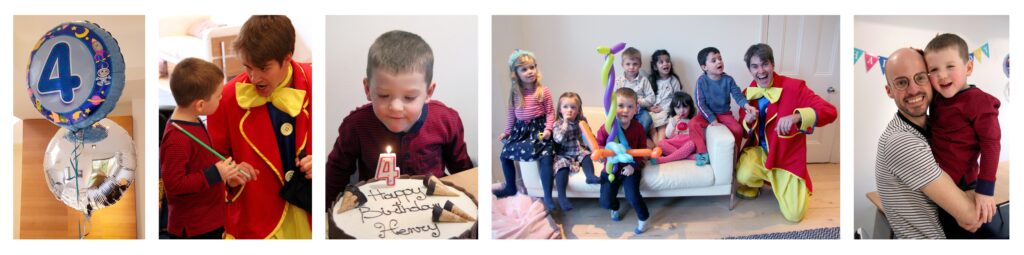
Image 1: The ‘establishing’ shot
The first image, the ‘establishing shot’, is used to give the viewer an idea what the story will be about and/or where the action will take place. It will help to put the rest of the photos into context. In the example above, the balloons give a clear indication that the action will be set around a four-year-old’s birthday party.
Image 2: Starting to reveal some details
Having established in general terms what the story is about or where it is set, the next image might be used to show the viewer who is part of the story and to convey a bit more about what is happening. In the example, we learn that the story is set at a little boy’s birthday party, with the birthday boy clearly enthralled by the magician, who is apparently providing the entertainment at the party.
Image 3: Providing emotional context
Photography should not only capture visually appealing images but should also create memorable images with an emotional impact on the viewer. The next shot is often used to give the viewer a ‘feeling’ about the situation being conveyed in the story. Looking straight at the subject helps with this, and make sure that the background is not distracting. The subject might look sad or happy or show a sense of anticipation about what is going to happen next. In our example, the little boy is clearly enjoying being the centre of attention (both at the party itself and in the picture) and looks excited as he prepares to blow out the candle on his birthday cake.
Image 4: Additional context
This is often an ideal image to focus on some additional detail or details. It might not tell the whole story, but it can help with the build up to the outcome of the story. In the example, we see for the first time the other children at the birthday party, with the birthday boy in the centre, proudly holding a balloon sculpture made by the magician.
Image 5: The end of the story
The final image in the sequence might be anticipated by the viewer, or it could come as a surprise – or even be left open to interpretation. Last impressions count and it’s worth considering what you want the viewer of your photos to remember or take away from your story. In our example, the birthday boy is being held tightly and lovingly by his daddy, and both are looking very happy indeed – obviously a good time was had by all!
Special thanks to the star of the story, who you may have guessed happens to be my lovely grandson, Henry, for providing the inspiration for the story (3 years ago!).
———-
Finally…
- As it says in the title of the previous section, these are guidelines, not rules, and you should structure your images to tell your own story in your own way.
- Your story can be about anything you like – family, travel, adventures, concerts or gigs, hobbies… the list is endless. Do have a go!
What’s required
***Please prepare 5 individual images, plus a single composite collage or montage of all five of your images, which can take whatever form you like.***
- You should choose a fitting title for your story (eg ‘A magical birthday party’) and use it for the collage or montage of all five of your images.
- Submit your five individual images with that same title plus 1, 2, 3, 4 and 5 in order eg ‘A magical birthday party 1’; ‘A magical birthday party 2’; etc.
Submission
Please submit your composite image and five individual images by WeTransfer by the end of the month (Sunday 30 April) to web@bishopthorpecc.co.uk.
Please adhere to the guidelines for submission as set out for ‘Challenges’ under Submitting Images on the BCC website.
In particular, to help the web team, please check the following list:
- Images should be JPEG files.
- Image dimensions must be a maximum of 1600 pixels wide or 1200 pixels high.
- Image sizes must be less than 500kb. If not, please save your images at a lower resolution until they are.
- The ‘title metadata field’ should include your ‘image title’ and‘your name’ as in the following example: A magical birthday party, Sue Hoggett; A magical birthday party 1, Sue Hoggett; A magical birthday party 2, Sue Hoggett; etc
- There must be NO other metadata in the caption (Note to Olympus users, you will have to delete ‘Olympus digital camera’’ from the caption field, and others where that sort of extraneous information appears there)
- Your images should also be saved with file names as in the metadata, for example: A magical birthday party, Sue Hoggett; A magical birthday party 1, Sue Hoggett; A magical birthday party 2, Sue Hoggett; etc
Acknowledgements and further inspiration
The beginner photography podcast: The 5 photos you need to tell any story: https://www.beginnerphotographypodcast.com/photography-tips/the-5-photos-you-need-to-tell-any-story
8 best creative storytelling photography ideas: https://expertphotgraphy.com/storytelling-photgraphy/
The 6 fundamentals of storytelling in photography: https://www.lightstalking.com/storytelling-through-photography/
The power of storytelling through photography: https://markbrion.com/the-power-of-storytelling-through-photography1/
How to do storytelling with your images: 8 useful tips: https://digital-photography-school.com/8-tips-storytelling-images/
Telling stories with photos: how to captivate your audience like a pro: https://digital-photography-school.com/telling-stories-with-photos/